



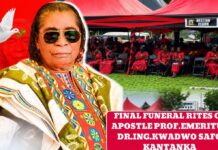

























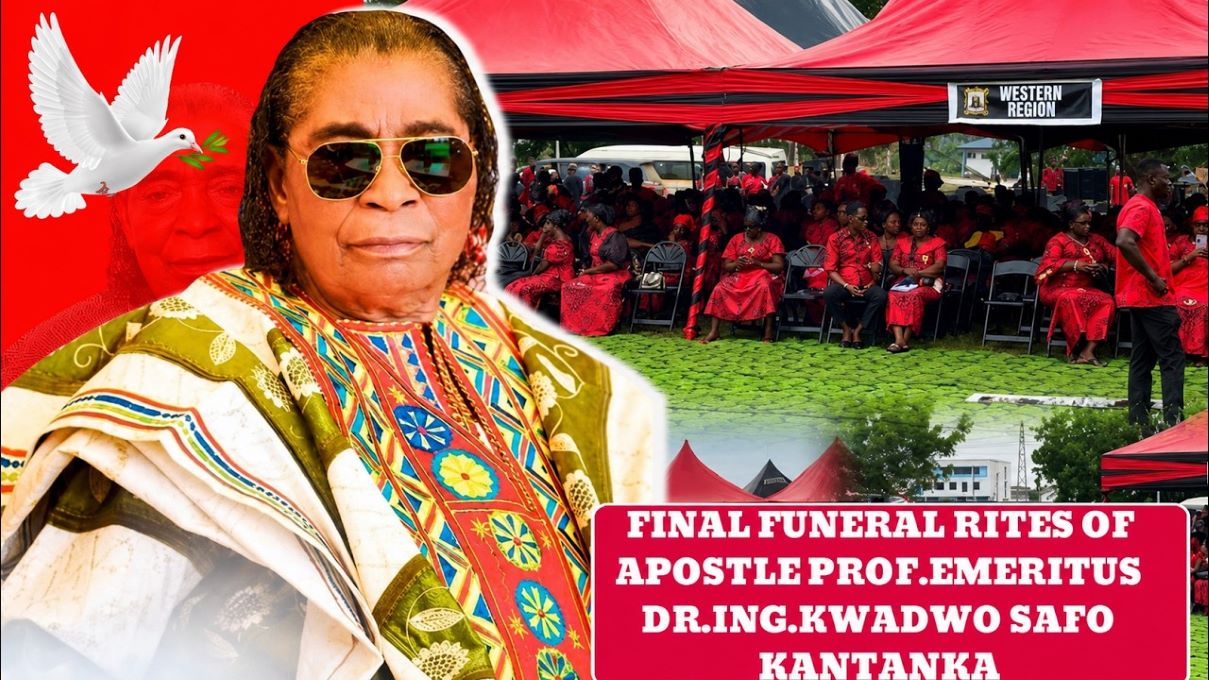
Apostle Professor Emeritus Engineer Kwadwo Safo Kantanka, the renowned Ghanaian inventor, industrialist, philanthropist and founder of the Kristo Asafo Mission and Kantanka Group, has become the center of one of Ghana’s most closely watched family and succession disputes following his death in September 2025.
According to GhanaSky.com analyst, what was expected to be a dignified national farewell to one of Ghana’s most distinctive innovators has instead been overshadowed by disagreements among members of his family over his succession, interpretation of his will, control of his remains, funeral arrangements and the future leadership of the Kristo Asafo Mission.
The dispute has become particularly serious because two competing positions have emerged within the family. One side has been associated with Sarah Adwoa Safo, who has presented herself as the recognised head of the family and has led preparations for the funeral. The other is associated with Nana Kwadwo Safo Akofena, also known as Israel Kwadwo Safo, who says the late Apostle’s final wishes and the paternal family structure give him authority over the family and funeral arrangements.
The disagreement has already entered the courts and, in June 2026, culminated in a violent incident in which Adwoa Safo sustained gunshot injuries at a property linked to her brother. Both sides have given competing accounts of the incident.
As of July 31, 2026, the funeral controversy remains a major national story.
Who Was Apostle Kwadwo Safo Kantanka?
Apostle Dr. Ing. Kwadwo Safo Kantanka was born on August 26, 1948, in Bekwai in Ghana’s Ashanti Region and died on September 11, 2025, aged 77.
He became famous in Ghana as a religious leader, inventor, industrialist, farmer, philanthropist and advocate of African technological self-reliance.
He founded the Kristo Asafo Mission, which began as a prayer group before developing into an organised religious movement.
He subsequently built the Kantanka industrial empire, with interests and activities spanning automobiles, engineering, electronics, agriculture and other forms of technological innovation.
His name became particularly associated with Kantanka Automobile, through which he promoted the idea that Ghana and Africa could develop their own industrial and automotive capabilities rather than remaining dependent on imported technology.
His legacy therefore extends beyond his immediate family.
For many Ghanaians, Apostle Safo represented the idea of African invention, local manufacturing and self-reliance.
Apostle Kwadwo Safo Kantanka Funeral: What Happened?
The original funeral arrangements announced by Sarah Adwoa Safo and the funeral planning committee scheduled the burial for July 30, 2026, at Gomoa Mpota in the Central Region, followed by a national farewell ceremony at Independence Square in Accra on July 31.
Earlier reports indicated that a thanksgiving service would subsequently be held in Kumasi.
However, the arrangements became increasingly controversial.
On July 23, the family issued a statement saying that no official funeral date had been fixed, distancing itself from invitations, posters and social-media announcements bearing July 30, July 31 and August dates.
On July 27, Nana Kwadwo Safo Akofena publicly stated that there would be no burial on July 30, insisting that the family had not officially announced such a date.
Sarah Adwoa Safo, however, maintained that the funeral arrangements had been finalised and that her father’s burial would proceed.
That disagreement eventually reached the High Court.
Ghana Court Stops Funeral Arrangements
On July 29, 2026, an Accra High Court granted a 10-day interim injunction restraining Sarah Adwoa Safo from proceeding with the funeral and burial arrangements for Apostle Kwadwo Safo Kantanka.
The order came amid the dispute over the late Apostle’s will and who had the authority to organise his burial.
The court intervention meant that the long-publicised July 30 burial date became legally contested.
Yet the situation did not end there.
Reports on July 30 indicated that mourners gathered at Gomoa Mpota despite the injunction, while subsequent reports said funeral activities proceeded and that Nana Kwadwo Safo Akofena did not attend.
This has created an unusual situation in which the funeral itself, the authority to organise it and compliance with the court order have all become part of the wider controversy.
Why Is the Kwadwo Safo Family Fighting?
The conflict cannot be reduced simply to a disagreement over a funeral date.
At its center are several interconnected issues:
- Who is the legitimate head of the family?
- Who should succeed Apostle Kwadwo Safo in the Kristo Asafo Mission?
- Who has authority over his remains?
- How should his will be interpreted and implemented?
- Who should control or administer aspects of his legacy and institutions?
- What role should the 2024 church constitutional changes play in succession?
- How should his children and wider family participate in the funeral?
These questions became much more difficult after the death of the patriarch.
The Will: The Most Important Document in the Dispute
One of the most significant developments was the emergence of Apostle Kwadwo Safo’s will.
Reports about the will say it was prepared in 2022 and contained detailed instructions concerning his funeral and family succession.
According to reports on the document, Apostle Safo directed that his son Nana Kwadwo Safo Akofena should become head of the paternal family and that his children should recognise and respect him in that capacity.
The reported will also contained unusually specific instructions concerning his burial.
It reportedly stated that members of his maternal family could attend his funeral but should not exercise control over his body, burial or funeral arrangements.
The will also reportedly stated that he did not want a state burial or state funeral.
Another reported instruction concerned the establishment of a memorial center at Gomoa Mpota to preserve aspects of his work and legacy.
These provisions are important because they appear to support Nana Akofena’s position concerning the paternal family.
However, the existence of a will does not automatically eliminate questions about how its provisions interact with the constitution of the Kristo Asafo Mission, customary law, family authority and other legal issues.
That is one reason the matter has become a court dispute.
The Two Sides of the Succession Dispute
Sarah Adwoa Safo’s Position
Sarah Adwoa Safo has presented herself as the recognised head of the Kwadwo Safo family.
In a June 2026 statement, the family associated with Adwoa Safo argued that although Apostle Safo had previously designated Israel Kwadwo Safo Akofena as a successor in 2017, the arrangement was later changed.
The statement claimed that the late Apostle revoked Akofena’s mandate in 2024 and that Adwoa Safo was subsequently appointed Head of the Family.
It further claimed that the church’s governing framework had been amended in 2024 in a manner that affected the succession question.
Adwoa Safo’s camp has therefore argued that Akofena cannot simply assume control of the Kristo Asafo Mission on the basis of the earlier succession arrangement.
Her lawyers have also argued that Akofena had been removed from the “crown prince” position before his father’s death, although they acknowledge that attempts to amend the will to reflect subsequent arrangements were not completed before Apostle Safo died.
Nana Kwadwo Safo Akofena’s Position
Nana Kwadwo Safo Akofena, also known as Israel Kwadwo Safo, has maintained a different position.
His supporters point to the late Apostle’s will, particularly the reported provision naming him head of the paternal family.
According to reports, the will specifically instructed the late Apostle’s children to recognise Akofena as head of the paternal family established during his lifetime.
His side has therefore argued that the funeral should comply with the late Apostle’s final wishes.
Akofena also became associated with the leadership of the Kristo Asafo Mission, although his claim to that position has been challenged by other family members and church members.
The Church Constitution Adds Another Layer
The dispute is not only about the family.
The Kristo Asafo Mission has its own governing framework.
Two church members filed a case at the Accra High Court seeking clarification and enforcement of the church’s constitutional provisions concerning succession.
The plaintiffs asked the court to consider the 2017 constitution and its 2024 amendment and determine how leadership succession should be handled. They also challenged the recognition of Israel Kwadwo Safo Akofena as leader.
This means there are effectively two overlapping questions:
Family succession
Who should head Apostle Safo’s paternal family?
Church succession
Who should lead Kristo Asafo Mission?
Those two positions do not necessarily have to be held by the same person, which helps explain why the dispute became so complicated.
Profile of Apostle Kwadwo Safo Kantanka’s Children
Public reporting has not always been consistent about the exact number of Apostle Safo’s children. Some older biographical sources list six, while more recent reporting surrounding the funeral has identified seven children, with six appearing publicly alongside Sarah Adwoa Safo at the May 29, 2026 funeral press conference.
Because of these inconsistencies, the safest approach is to identify the children according to the most recent family-related reporting rather than present older biographical lists as definitive.
The seven names reported are:
- Sarah Adwoa Safo
- Ruth Adwoa Safo
- Rebecca Adwoa Safo
- Abraham Yaw Safo
- Josibeth Adwoa Safo
- Obed Kwadwo Safo
- Kwadwo Safo Jnr / Nana Kwadwo Safo Akofena
Recent reporting specifically identified the six children who appeared at the May 29 funeral press conference as Sarah Adwoa Safo, Ruth Adwoa Safo, Rebecca Adwoa Safo, Abraham Yaw Safo, Josibeth Adwoa Safo and Obed Kwadwo Safo, while Kwadwo Safo Jnr was absent.
Because some publications use different spellings and naming conventions, readers should be cautious when comparing older biographies.
1. Sarah Adwoa Safo Profile
Sarah Adwoa Safo is arguably the most publicly recognisable of Apostle Safo’s children.
She is a lawyer, politician and former Member of Parliament for Dome-Kwabenya.
She served in Parliament from 2013 to 2025 and also served as Minister for Gender, Children and Social Protection under President Nana Akufo-Addo.
Following her father’s death, she became one of the central figures in the family and funeral arrangements.
She has also emerged as the principal public face of one side of the succession dispute.
Her position became even more prominent after the June 2026 shooting incident at Kwabenya, in which she sustained injuries.
She has denied allegations that she carried or fired a gun during the confrontation.
2. Nana Kwadwo Safo Akofena / Israel Kwadwo Safo
Nana Kwadwo Safo Akofena, also referred to as Israel Kwadwo Safo, is one of the most important figures in the current succession dispute.
He is a son of Apostle Kwadwo Safo and has been associated with the leadership of the Kristo Asafo Mission.
His position is especially significant because the reported will names him as head of the paternal family.
At the same time, his leadership claim has been challenged by his sister Adwoa Safo and other church members.
The disagreement over his position is one of the major factors behind the current family crisis.
3. Kwadwo Safo Jnr
Kwadwo Safo Jnr is another prominent son of Apostle Kwadwo Safo and is strongly associated with the Kantanka business legacy.
He has been identified as a businessman, entrepreneur and pilot and has served as CEO of Kantanka Group/Kantanka Automobile.
He has also publicly acknowledged that sibling rivalry can exist within a large family but stressed the importance of succession planning.
In an interview before the current crisis intensified, he argued that founders of African family businesses should appoint successors while they are still alive so that they can guide the transition.
More recently, he appealed for unity after the Kwabenya violence, saying that his late father would have been deeply disappointed by the conflict and warning that division could damage Apostle Safo’s legacy.
4. Ruth Adwoa Safo
Ruth Adwoa Safo has been identified in recent reporting as one of Apostle Safo’s daughters.
She appeared among the siblings publicly introduced during the May 29 funeral briefing led by Sarah Adwoa Safo.
Unlike Sarah Adwoa Safo and Kwadwo Safo Akofena, Ruth has not been as prominent in the public dispute.
Her lower media profile makes it important not to attribute positions to her without direct evidence.
5. Rebecca Adwoa Safo
Rebecca Adwoa Safo is another daughter identified in the recent family presentation.
She was listed among the children present at the funeral press conference in May 2026.
Public reporting provides considerably less information about her professional and personal activities than it does about Sarah Adwoa Safo.
She is therefore best described as a member of the late Apostle’s family rather than assigning her an unverified role in the succession conflict.
6. Abraham Yaw Safo
Abraham Yaw Safo was also named among Apostle Safo’s children during the May 2026 funeral briefing.
Like Ruth and Rebecca, he has remained relatively private compared with the siblings at the center of the leadership dispute.
Recent reports identify him as one of the children who appeared with the family during the funeral preparations.
7. Josibeth Adwoa Safo
Josibeth Adwoa Safo, also referred to in some reports with a slightly different spelling, was identified among Apostle Safo’s children at the May 2026 press conference.
She has not been a major public figure in the succession battle.
Consequently, there is insufficient reliable public information to assign her a specific position in the dispute.
8. Obed Kwadwo Safo
Obed Kwadwo Safo was also introduced as one of Apostle Safo’s children during the May 2026 funeral announcement.
He is among the children whose public profile is considerably smaller than that of Sarah Adwoa Safo, Kwadwo Safo Jnr and Nana Akofena.
Recent reporting indicates that he was among the siblings present during the family presentation.
Why Did the Conflict Become So Serious?
The family conflict appears to have developed from several overlapping disputes rather than one single incident.
1. Leadership of Kristo Asafo
The first major question was who should take over the leadership of the Kristo Asafo Mission after Apostle Safo’s death.
An earlier succession arrangement reportedly favoured Akofena.
A later family position claimed that this arrangement had been revoked.
That disagreement became the foundation of the wider struggle.
2. The 2024 Church Changes
The 2024 amendment to the church’s governing structure became important because one side argued that it changed the succession framework.
Church members subsequently went to court seeking interpretation of the constitution and challenging Akofena’s leadership claim.
3. The Interpretation of the Will
The reported will appears to favour Akofena concerning leadership of the paternal family.
However, Adwoa Safo’s camp has argued that later developments altered the succession situation.
This created a major question:
Should the succession be determined primarily by the will, the church constitution, subsequent appointments, customary family authority, or a combination of these?
That question ultimately moved beyond family discussions and into court.
4. Family Property and Inheritance
Some reports have also linked the dispute to inheritance and family property.
Sources cited by Graphic Online described the Safo family as a large multi-mother family and said disagreements concerning property could be contributing to the tension. Another source, however, insisted that the dispute was primarily about church leadership rather than inheritance because Apostle Safo had left a will.
Therefore, it would be inaccurate to claim definitively that money or property alone caused the conflict.
The available reporting indicates that succession, church leadership, family authority, the will and property issues became intertwined.
The June 21 Shooting Incident
The family dispute reached an alarming point on June 21, 2026, when Sarah Adwoa Safo was injured in a shooting incident at a property associated with her brother, Nana Akofena.
The incident occurred amid the dispute over the proposed leadership transition.
Adwoa Safo’s side said she had gone to serve court documents concerning the attempted installation or recognition of Akofena.
The other side has disputed aspects of that account and provided its own version of events.
Police subsequently investigated the incident, and arrests were made.
Adwoa Safo later denied allegations that she had been carrying or firing a weapon.
Because the matter involves ongoing legal proceedings and competing accounts, claims about who fired first or precisely what happened should not be treated as established facts unless determined by the court.
Was Nana Akofena Officially Installed as Church Leader?
This is another area where reports have differed.
A lawyer for Kristo Asafo explained that the gathering preceding the June confrontation was intended to introduce Akofena as the chosen successor rather than constitute a formal installation.
According to the lawyer, formal installation was expected only after the funeral and after consensus among relevant family and church stakeholders.
Meanwhile, the Adwoa Safo-led family position rejected the legitimacy of Akofena’s assumption of leadership.
Therefore, headlines describing him simply as the uncontested successor can be misleading.
The succession question has been disputed.
Apostle Kwadwo Safo Kantanka’s Funeral Becomes the Battleground
Ironically, the dispute over succession has now directly affected the funeral of the very man whose death created the succession crisis.
Apostle Safo’s funeral was supposed to unite the family around his memory.
Instead, disagreements over who had authority to organise the funeral became another legal battlefield.
Nana Akofena’s side argued that the late Apostle’s will contained specific instructions concerning his remains and funeral.
Adwoa Safo’s side maintained that it had undertaken extensive consultations and finalised the arrangements.
The High Court’s July 29 interim injunction subsequently placed the planned funeral under legal restraint.
Apostle Kwadwo Safo’s Funeral and the Question of His Remains
One particularly sensitive issue is the question of who has custody or control of Apostle Safo’s remains.
The reported will allegedly instructed that his paternal family should handle the burial and that his maternal family should not control his remains.
Nana Akofena has argued that these instructions must be respected.
Adwoa Safo’s camp has disputed aspects of the implementation of the will and the authority being claimed by Akofena.
The controversy surrounding the remains is therefore not simply ceremonial.
It goes directly to the question of whether the late Apostle’s final instructions have been followed.
What Makes the Kwadwo Safo Family Dispute Different?
There are several reasons this dispute has attracted extraordinary attention in Ghana.
First: The family represents a major Ghanaian industrial legacy
Apostle Safo built a business and technological brand that became internationally associated with Ghanaian manufacturing.
Second: He founded a religious movement
Kristo Asafo is not merely a family business. It is a religious institution with its own membership, leadership structure and constitution.
Third: The family has prominent public figures
Sarah Adwoa Safo is a former MP and minister.
Kwadwo Safo Jnr is associated with the Kantanka business empire.
Nana Akofena is associated with the Kristo Asafo succession dispute.
Fourth: The dispute became violent
The shooting incident involving Adwoa Safo transformed an internal family dispute into a national security and criminal-justice story.
Fifth: The courts are now involved
The dispute over church succession and the funeral has moved beyond private family negotiations.
The Most Important Question: Who Is Right?
At this stage, it would be premature to declare that one side has definitively won every aspect of the dispute.
There are several separate questions:
Who is head of the paternal family?
The reported will gives significant support to Nana Akofena’s position.
Who should lead Kristo Asafo Mission?
That question has been challenged through the church’s constitutional framework and legal proceedings.
Who should organise the funeral?
The High Court’s interim injunction demonstrates that this question has become legally contested.
Was Akofena’s succession revoked before Apostle Safo died?
Adwoa Safo’s representatives say yes, while the legal significance of the incomplete changes remains contested.
What did Apostle Safo ultimately intend?
The reported will provides important evidence, but its implementation and relationship with later developments remain central to the dispute.
Apostle Kwadwo Safo Kantanka’s Legacy
Whatever happens in the family dispute, Apostle Safo’s contribution to Ghanaian society remains significant.
His legacy includes:
- The establishment of the Kristo Asafo Mission
- The development of Kantanka Automobile
- Promotion of Ghanaian engineering
- Agricultural experimentation and innovation
- Electronics and mechanical inventions
- Skills training
- Employment creation
- Philanthropic activities
- Promotion of African technological self-reliance
- Advocacy for indigenous manufacturing
- Development of technology exhibition centres
- Religious and community development
His work inspired both admiration and debate.
But his most enduring achievement may be the larger question he placed before Ghana:
Can Africans build their own technology, industries and institutions rather than depending permanently on imported solutions?
That question remains relevant long after his death.
Apostle Kwadwo Safo Funeral Latest Update — July 31, 2026
The latest situation is complicated.
The funeral programme originally announced for July 30–31 was disputed by another faction of the family.
Nana Akofena publicly rejected the July 30 burial date.
An Accra High Court subsequently issued a 10-day interim injunction against the funeral arrangements led by Sarah Adwoa Safo.
Nevertheless, reports on July 30 and July 31 indicate that mourners gathered and that funeral activities were conducted despite the legal dispute.
This means that the Apostle Kwadwo Safo funeral story is no longer simply about mourning.
It has become a major test of:
- Family authority
- Succession
- Customary law
- Church governance
- The interpretation of a deceased person’s will
- Estate administration
- Court authority
- And the preservation of a national industrial legacy
Reflection
Apostle Kwadwo Safo Kantanka spent his life building institutions that were larger than himself.
He built a church.
He built businesses.
He promoted Ghanaian manufacturing.
He trained people.
He championed technology.
He created the Kantanka brand.
But after his death, the question of who should inherit the authority surrounding those institutions has created a painful division among his children and associates.
The most tragic aspect of the controversy is that a funeral, which should ordinarily bring relatives together to celebrate the life of a departed patriarch, has itself become part of the succession struggle.
The final chapter of Apostle Kwadwo Safo Kantanka’s story will therefore not be determined only by where he is buried.
It will also be determined by whether his children can eventually resolve their differences and preserve the institutions and vision he spent decades building.
For now, the most responsible conclusion is that the Kwadwo Safo family dispute remains legally and factually contested, and several of its most important questions remain before the courts.