



































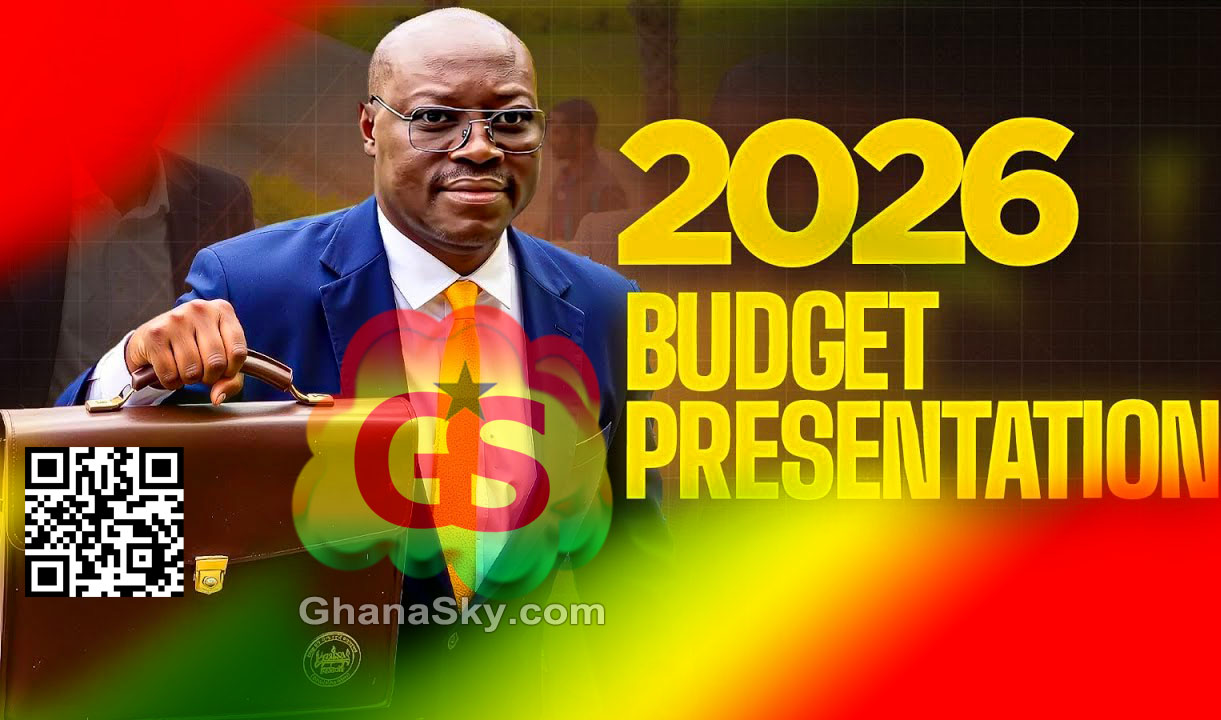
ACCRA: Ghana’s 2026 Budget, presented by Finance Minister Dr. Cassiel Ato Forson, outlines a bold plan for economic transformation.
Here are the major highlights, policy priorities, and what the budget means for ordinary Ghanaians according to GhanaSky.com analyst.
Chapter 1: Introduction & Macroeconomic Outlook
- The budget opens by highlighting Ghana’s gradual economic recovery: lower inflation, stabilising cedi, renewed investor confidence.
- For 2026, government targets real GDP growth of around 5%, driven by private-sector expansion, improved energy supply and expected gains in agriculture and industry.
- Macroeconomic policy objectives for 2026 include:
-
-
Maintaining fiscal discipline
-
Accelerating jobs and growth
-
Protecting vulnerable citizens
-
Advancing structural and public-sector reforms
-
Chapter 2: Fiscal Policy & Debt Sustainability
- Government commits to achieving a primary surplus in 2026 to anchor debt sustainability.
- The strategy includes controlling expenditure growth, improving domestic revenue mobilisation, and strengthening arrears management.
- Clear targets are set for overall deficit reduction and gradual lowering of the debt-to-GDP ratio over the medium term.
- Emphasis on predictable and transparent public spending, with stricter cash-flow controls.
Chapter 3: Revenue Mobilisation & Tax Policy
- Focus on widening the tax base through improved compliance, enhanced digital tax systems and stronger monitoring of non-tax revenue.
- The budget discontinues certain pandemic-era levies to ease burdens on households and businesses.
- Adjustments to VAT and tax exemptions aim to balance fairness with revenue needs.
- Measures to support private-sector expansion include targeted reliefs for sectors such as agriculture, manufacturing and renewable energy.
Chapter 4: Expenditure Priorities & Public Investment
-
Capital spending prioritises:
-
Roads and transport infrastructure
-
Water and sanitation projects
-
Energy generation and transmission
-
Irrigation and agricultural mechanisation
-
-
Strong emphasis on job-creating initiatives, with government targeting close to 800,000 jobs across sectors in 2026.
-
Social sectors—education, health and social protection—remain heavily funded to strengthen human capital.
-
Spending efficiency and value-for-money assessments are highlighted as a priority.
Chapter 5: Sectoral Strategies
Agriculture
-
Boost mechanisation, irrigation and access to improved seedlings.
-
Expand feeder roads and market access to support value-chain development.
Industry & Manufacturing
- Support local production and import substitution.
- Scale up incentive schemes for manufacturers and industrial parks.
Energy & Natural Resources
- Plans for additional power-generation capacity, including a new large-scale thermal facility.
- Support for new investments in oil and gas exploration and production.
- Commitment to improve reliability of electricity for homes and businesses.
Infrastructure & Transport
-
Prioritisation of major road networks, bridges, market redevelopments and regional transport corridors.
Human Capital Development
- Expand youth skills training, digital skills programmes and TVET funding.
- Increase resources for primary health care, maternal services and disease-control programmes.
Governance & Public Sector Reform
- Digital transformation of public services
- Strengthening procurement, audit and accountability mechanisms
- Performance-based budgeting across MDAs and MMDAs
Chapter 6: Social Protection & Inclusivity
-
Government commits to shielding vulnerable groups from the effects of fiscal consolidation.
-
Expanded programmes include:
-
Livelihood Empowerment Against Poverty (LEAP)
-
School feeding improvements
-
Support for persons with disabilities
-
Community-based nutrition and health outreach
-
-
Emphasis on closing inequality gaps, especially in rural and peri-urban areas.
Chapter 7: Public Financial Management Reform
- Strengthens systems for expenditure control, payroll management and public procurement.
- Enhanced arrears-clearance strategy to improve private-sector liquidity.
- Improved monitoring of SOEs and management of contingent liabilities.
- Rollout of updated programme-based budgeting tools.
Chapter 8: Risks & Mitigation Measures
- Identifies risks including revenue shortfalls, global economic conditions, commodity-price volatility and exchange-rate pressures.
- Mitigation strategies include maintaining macro buffers, diversifying exports, boosting domestic revenue and strengthening financial-sector oversight.
- Government emphasises cautious but realistic assumptions for 2026.
Chapter 9: Medium-Term Framework (2026–2029)
-
Outlines projected revenue growth, expenditure ceilings and debt-reduction targets.
-
Focus shifts from “stabilisation” (2023–2025) to “transformation and expansion” in 2026 and beyond.
-
Medium-term priorities:
-
Job-intensive industrialisation
-
Enhancing agricultural productivity
-
Deepening digital government
-
Expanding renewable energy
-
Strengthening social protection
-
Chapter 10: Implementation, Monitoring & Accountability
- Quarterly performance reviews and public reporting to improve transparency.
- Collaboration with civil society, academia and the private sector in monitoring programmes.
- Commitment to produce a simplified “Citizens’ Budget” for public understanding.
- Emphasis on evidence-based budgeting and measurable outcomes for every ministry.
Key Measures Announced
- Removal of specific pandemic-era levies to ease cost of living.
- Target of nearly 800,000 new jobs in 2026.
- Large-scale power-generation investments, including a new state-owned thermal project.
- Additional multi-billion-dollar investments expected in the energy and petroleum sector.
- Strengthened targeting and funding of social protection programmes.
- Renewed commitment to transparent public spending and arrears clearance.
Read Full Ghana 2026 Budget Text Statement Below: